
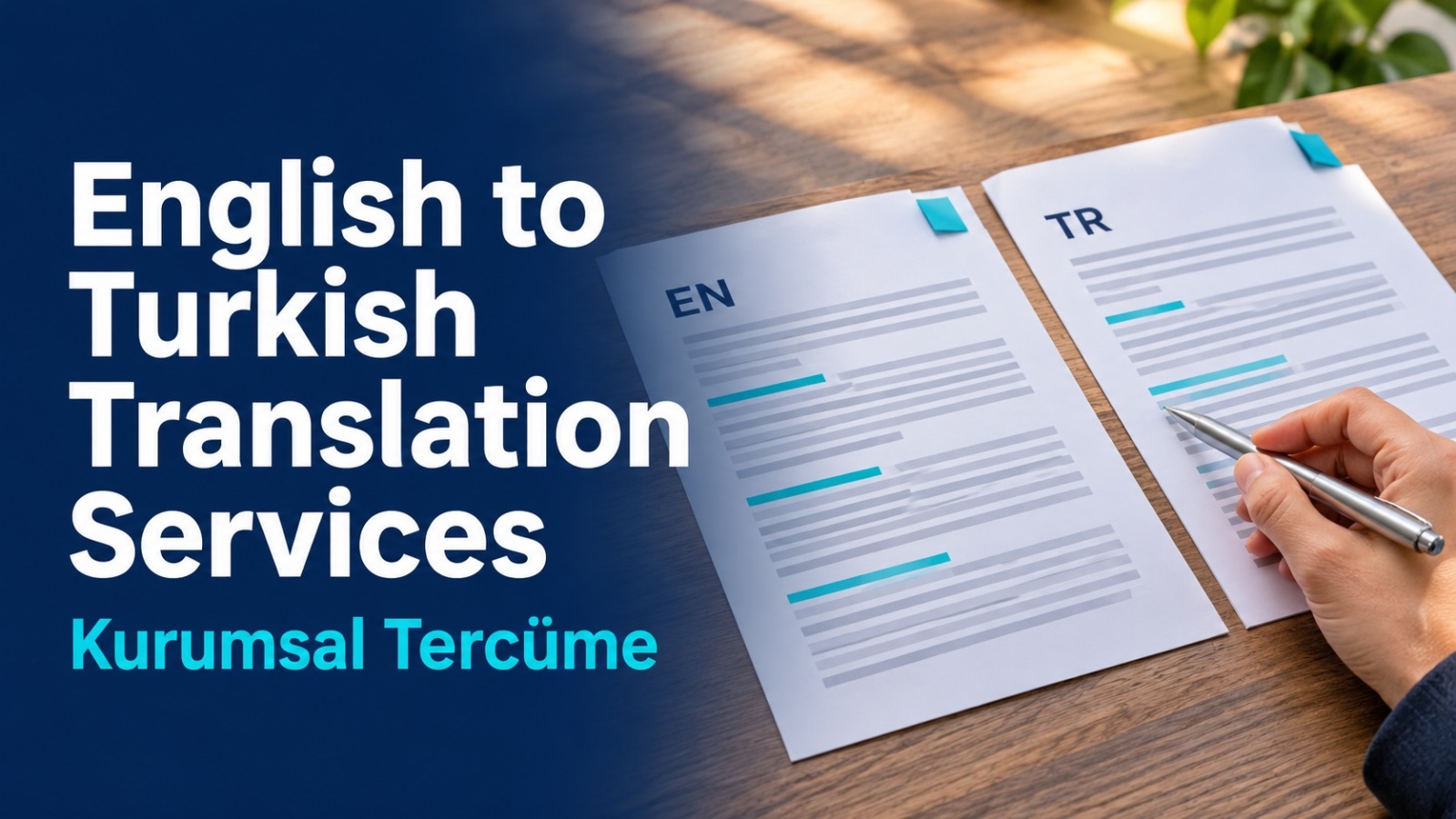
English to Turkish Translation Services
İndirimli çeviri fiyat listemiz ve teklif talepleriniz için
OKEANOS TERCÜME: 0553 910 31 32
English to Turkish translation services help individuals and businesses prepare documents for a specific reader, purpose or submission. A useful translation must do more than sound natural: it must preserve the meaning, terminology, names, figures and conditions in the source document while presenting them clearly in the target language.
Through Kurumsal Tercüme, a brand of Okeanos Uluslararası Çeviri ve Yeminli Tercüme, you can request English to Turkish and Turkish to English translation for personal documents, business materials and specialist texts. Share your files together with their intended use, any receiving institution’s instructions and your preferred deadline so that the scope can be assessed before work begins.
English to Turkish and Turkish to English Translation
The direction of translation is the starting point, not the complete specification. A contract for internal review, a diploma for an application and a product catalogue for customers require different terminology, presentation and delivery arrangements.
For English to Turkish translation, the wording should read naturally in Turkish without losing qualifications, exceptions or obligations expressed in the English source.
For Turkish to English translation, the intended audience matters just as much. If your organisation has an approved glossary, an English style guide or a preference for British or American English, provide it at the outset.
If you need both language versions for the same project, identify which document is the source and how later revisions will be managed. For contracts, any question about which language version takes precedence should be addressed by the parties and their legal advisers rather than decided through translation.
Documents and Content We Translate
Okeanos’s translation services cover personal, corporate and specialist document needs. The terminology, file preparation and review requirements are assessed according to the material and its intended use.
| Document or content | Important translation considerations |
| Contracts and business agreements | Defined terms, obligations, exceptions, deadlines and references to schedules |
| Company documents and commercial correspondence | Registered names, titles, company details and consistent business terminology |
| Diplomas, transcripts and certificates | Personal details, institution names, course information, grades and annotations |
| Academic papers and research texts | Subject terminology, methodology, findings and consistency between sections |
| Technical manuals and product documentation | Instructions, warnings, units, model numbers and references to diagrams |
| Financial reports and tables | Amounts, currencies, reporting periods, notes and number formatting |
| Websites, catalogues and presentations | Audience, brand voice, product information and layout constraints |
A single project may contain several document types. For example, a supply agreement may include technical specifications, pricing schedules and supporting certificates. These should be identified together so that terminology and cross-references remain consistent throughout the project.
If you prefer to review the service information in Turkish, visit our English–Turkish translation page, available in Turkish.
EN ISO 17100-Certified Translation Services
Okeanos holds EN ISO 17100 certification and carries out translation work in accordance with the standard’s requirements within its certified scope. EN ISO 17100 is the European adoption of the international standard for translation services. It establishes requirements for the processes, professional resources and project management needed to deliver translations that meet agreed client specifications. These include translator and reviser competence, translation checking, revision by another qualified person and controlled project delivery. For clients, certification provides a recognised international framework for assessing how a translation service is organised and quality-controlled—not simply how fluent the finished text appears.
This certification concerns the provision of translation services; it is not a substitute for notarization, an apostille or a receiving institution’s own submission requirements.
Tell Us Where Your Translation Will Be Used
Before requesting a translation, clarify what the finished document needs to do.
A company may need a Turkish version of an English report for internal discussion. Another client may need an English translation of a Turkish certificate for a university application. Both involve translation, but the receiving audience and submission requirements may differ.
Include the following information with your request:
- The source and target languages.
- The purpose of the translation.
- The country, institution or organisation receiving it.
- Any written submission instructions.
- Your preferred delivery date.
- The required file format and number of copies.
- Any terminology or spelling preferences already approved.
If you are submitting personal documents, provide the required spelling of names where relevant. Differences between an existing passport, earlier translations and the source document should be raised before preparation rather than silently standardised.
Sworn Translation and Notarization Requirements
Translation, sworn translation and notarization are not interchangeable requests. The appropriate arrangement depends on the document and the receiving institution’s requirements.
Do not assume that every English document used in Türkiye needs notarization, or that a translation prepared for one institution will automatically meet another institution’s conditions.
Before ordering a translation for an official submission, ask the receiving institution:
- Is a translator’s declaration, signature or stamp required?
- Is notarization required?
- Must an original document or an officially issued copy be presented?
- Are scanned translations accepted?
- How many copies are needed?
- Is an apostille or another authentication procedure required?
Terminology can differ between countries. If an institution asks for a “certified translation,” send its exact instructions rather than relying on the label alone.
For public documents used abroad, the HCCH Apostille Section explains the Apostille Convention and provides information on designated competent authorities. An apostille is a separate authentication matter; it should not be treated as another name for translation.
Share any relevant instructions with your files so that the translation request can be assessed against the stated requirements. The receiving institution remains responsible for its acceptance decision.
English to Turkish Translation Process and Quality Checks
A clear translation brief makes it easier to define what will be translated, which references will be used and what the final delivery should contain.
File and scope assessment
The initial assessment considers the language direction, document type, volume, readability, formatting needs and requested deadline.
Include attachments, reverse sides, tables, notes and text embedded in images. If only selected sections need translation, identify them precisely.
An unreadable stamp, missing page or incomplete sentence should be flagged. Unclear source information should not be reconstructed through guesswork.
Terminology and reference materials
Approved terminology helps maintain consistency across a document or a series of files. Useful references may include:
- Previous approved translations.
- Product specifications and model lists.
- Corporate terminology guides.
- Published institutional names.
- Author or publisher instructions.
Consistency does not mean translating a word the same way regardless of context. The intended meaning must still be checked.
Translation, checking and revision
The translator checks the completed work against the source text. Revision by another qualified person provides a separate comparison of the source and target texts, considering accuracy, completeness and suitability for the agreed purpose.
Relevant checks include:
- Names, titles and organisation details.
- Dates, amounts, currencies and units.
- Negatives, exceptions and conditional statements.
- Defined terms and abbreviations.
- Tables, footnotes and attachments.
- Section numbers and cross-references.
A fluent target text can still contain an omission or a changed condition. Source comparison is therefore important even when the translation reads smoothly.
Delivery format
Specify whether you need an editable document, a PDF or printed copies. A file intended for further editing has different practical requirements from a final document prepared for submission.
For complex layouts, clarify the expected formatting work before the project begins.
Why Small Details Matter: English–Turkish Examples
The following illustrative examples show why context and document-level checking matter. They are not customer cases.
| Source detail | Potential issue | What needs checking |
| 03/04/2026 | The day and month may be interpreted differently | Confirm the date convention before making it explicit |
| 1,250.50 | Separators may change when presenting the amount in Turkish | Preserve the numerical value and apply consistent formatting |
| “The supplier shall not disclose the information unless authorised in writing.” | Omitting “not” or the written-authorisation exception changes the obligation | Preserve both the prohibition and its exception |
| A reference to “Schedule 2” | The attachment may be missing or labelled inconsistently | Check the reference against the complete document |
| A product name appearing in several forms | The reader may think different products are involved | Compare names and model codes with approved references |
For illustration, the contractual sentence above could be expressed as:
Tedarikçi, yazılı olarak yetkilendirilmedikçe bilgileri açıklamayacaktır.
This illustrates the relationship between the prohibition and the exception. The final wording in an actual agreement would also depend on its defined terms and surrounding clauses.
Preparing Your Files for Translation
Send the latest agreed version whenever possible. If revisions are still expected, explain how updated files will be identified.
Before sharing your documents:
- Check that all pages and attachments are included.
- Make sure scans are complete, upright and readable.
- Identify content that should remain untranslated.
- Provide editable source files where available.
- Include a PDF reference if layout needs to be preserved.
- State any required spelling for names or specialist terms.
- Share the receiving institution’s instructions.
- Confirm your preferred delivery date and format.
For confidential business materials or personal records, contact us to confirm an appropriate sharing method. Do not place sensitive documents in public comment sections.
If the source changes after translation has started, identify the revised passages clearly. A new version may affect terminology, cross-references, scope and the delivery plan.
What Affects Translation Cost and Delivery Time?
English to Turkish translation costs depend on more than the number of pages. Two documents with the same page count can contain very different amounts of text and require different levels of specialist work.
The assessment may consider:
- Source text volume and language direction.
- Subject matter and terminology.
- File quality and readability.
- Tables, diagrams and formatting.
- Requested review and delivery scope.
- Sworn translation or notarization requirements.
- Printed copies and delivery arrangements.
- The requested deadline.
For general information, see our English–Turkish translation pricing information, available in Turkish. A project-specific quotation should identify the charging basis, included services, applicable taxes and any separate costs.
If your deadline is urgent, state the required date and time when you first contact us. Feasibility should be confirmed after the files and any additional procedures have been assessed.
Request English to Turkish Translation Support
Whether you need to understand a commercial agreement, prepare documents for an application or communicate with Turkish-speaking customers, start with a clear description of the task.
Through Kurumsal Tercüme, Okeanos combines English–Turkish translation support with an EN ISO 17100-certified approach to translation service delivery. Send your files with the language direction, intended use and deadline to request an assessment and quotation. If a receiving institution has issued specific instructions, include them so that the proposed service can be considered in that context.
For quotations and enquiries:
- Email: info@kurumsaltercume.com.tr
- Telephone: +90 212 221 45 21
- Mobile / WhatsApp: +90 553 910 31 32
Kurumsal Tercüme is another brand of Okeanos Uluslararası Çeviri ve Yeminli Tercüme.